Glasser's master theorem
I haven’t posted in quite a while, and I feel pretty bad for not finishing the lattice posts yet (I’m working on them I promise) so here’s a short filler post about Glasser’s master theorem. I find it quite interesting, and the Wikipedia page doesn’t really contain much, so hopefully this will be useful.
the theorem
For and , we have that
Now let’s see an example of an integral that can be easily solved with this theorem.
Find .
A conventional method with partial fraction decomposition would be pretty unwieldy:
It’s very simple to make mistakes like sign errors in long workings like this.1 But using Glasser’s master theorem,
This looks much neater2 than the first solution.
the proof
From here onwards, we will assume that . Let’s take a look at what the substitution looks like. As a reminder, the theorem states that
where .
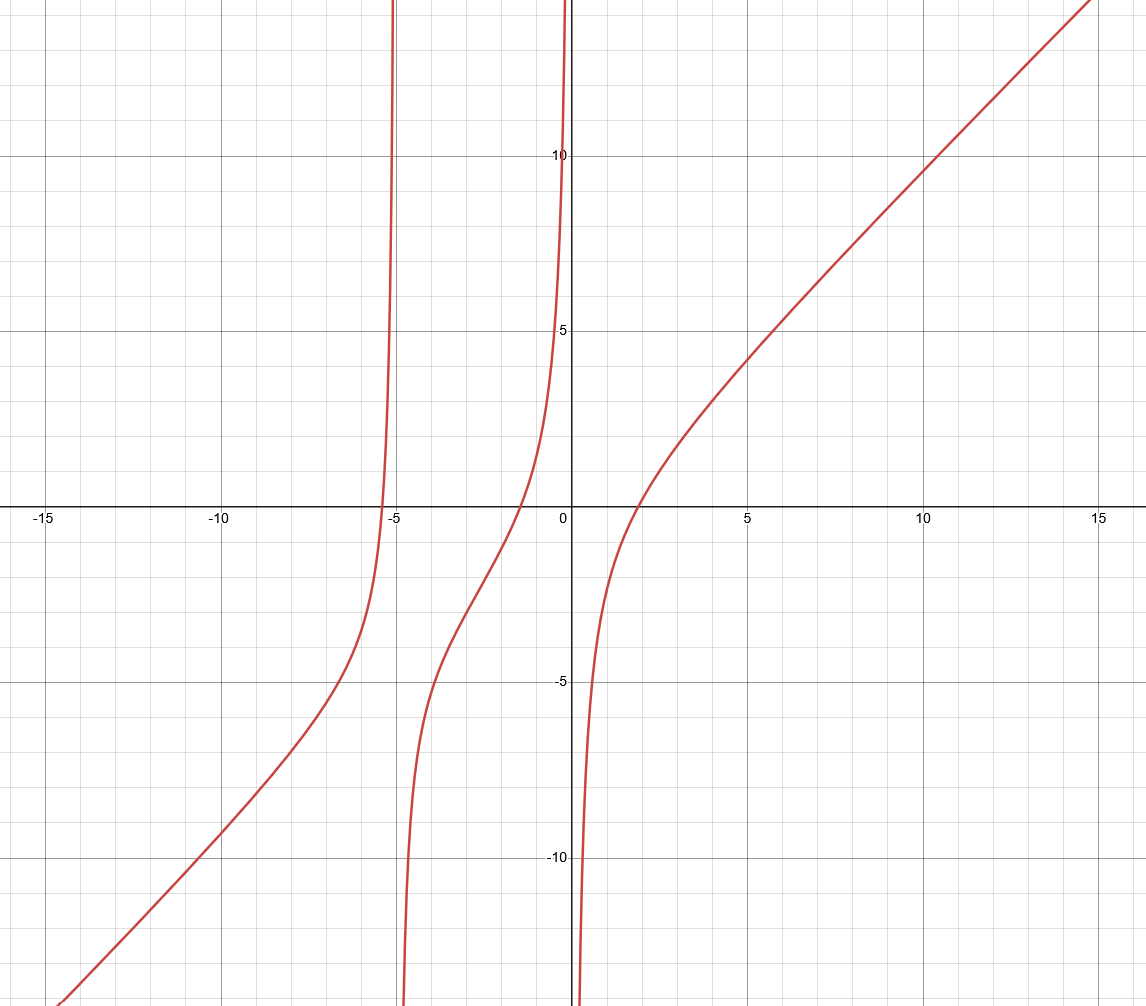
In general, the graph is made up of continuous “pieces”, with discontinuities between the pieces at . We can denote these pieces as , which are continuous on respectively. It’s easy to see that the inverses of these pieces, , all satisfy the equation . We will denote the inverses as .
Now, we consider the equation and multiply to get rid of the denominators in the expression of and obtain a polynomial in 3:
Expanding out the products, we get
Since this is a polynomial with degree , there are at most solutions, which are exactly . From Vieta’s formulas, we also know that .
Now we are ready to put everything together. We can split the original integral into pieces as follows:
and we then make the substitution for each integral to get
But how do we know what is? We can take the previously obtained expression for and differentiate with respect to to get
and so
Hence proven.
at least, i did when writing this
and much easier to typeset
note that here, can also be a function like . personally im not a great fan of this notation but eh